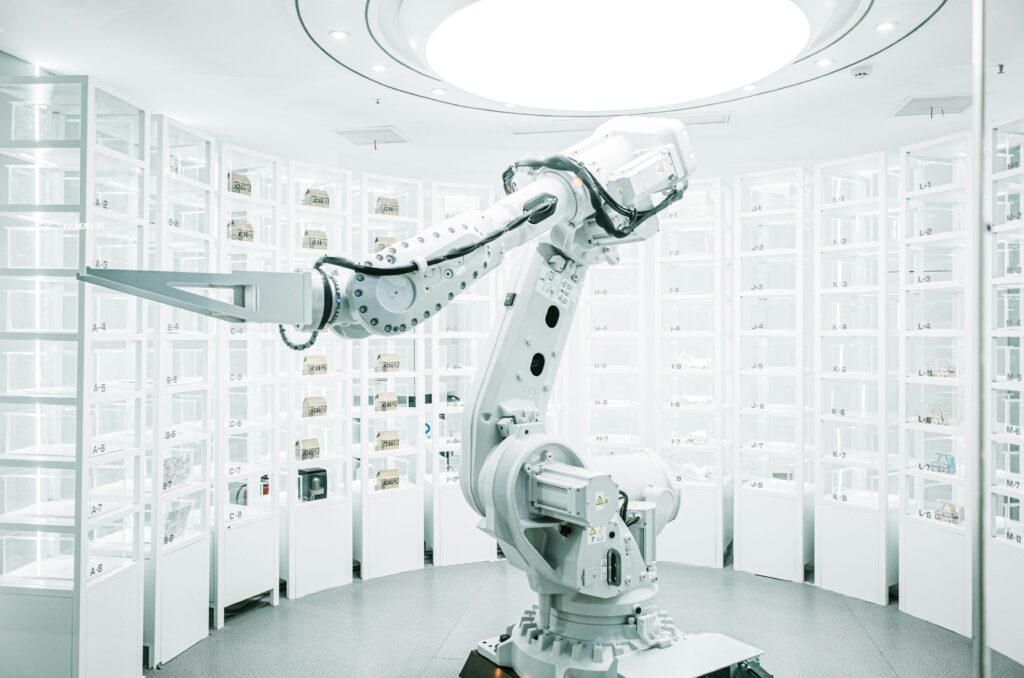
Last week, the Chinese AI company DeepSeek bought a stake in Unitree, one of China’s leading makers of humanoid robots. The two companies say they plan to work together on AI for robotics. Unitree, meanwhile, is collecting training data by having humans guide its robots through physical tasks. 1
At first glance, this looks like an obvious marriage: DeepSeek supplies the brains and Unitree supplies the body.
But there may be something considerably more important going on.
Large language models have become remarkably capable in large part by consuming enormous quantities of human-generated information: books, websites, code, images, video and so forth. There is still plenty to learn from these sources, and synthetic data can extend them. But high-quality human-generated training data is finite, and researchers have been worrying for some time about eventually running into a “data wall.” Synthetic data helps, although recent research suggests it is not a perfect substitute for fresh information from the real world. 2 3
Robots have access to a very different source of data.
Reality.
Imagine a robot learning to pick up boxes in a warehouse. One box is heavier than expected. Another has a slippery surface. A third collapses when squeezed too tightly. A wheel catches on a crack in the floor. A bolt loosens. A bracket flexes. Someone leaves a broom where it shouldn’t be.
Every one of these events creates information that probably doesn’t exist anywhere on the internet.
More importantly, reality supplies its own answer key.
The robot predicts what will happen, acts, and discovers whether it was right.
China may be unusually well positioned to exploit this. It already has an enormous manufacturing base and is making a major national push into robotics. More than 300 Chinese robotics companies showed products at this year’s World Robot Conference, and some analysts believe a large fraction of early humanoid robots may effectively be deployed as training-data collectors while useful commercial applications develop. 4 5
That creates a potentially powerful flywheel:
More robots → more physical experience → better AI → more capable robots → more deployment → still more experience.
But there is another step that may matter even more.
Humans don’t simply accumulate examples. We abstract from them.
If you’ve spent enough time building things, for example, you can sometimes look at a bracket and know that it is too flimsy before doing any calculations. You have experienced leverage, bending, stiffness and failure so many times that you’ve developed something like a physical intuition.
You can run the equations afterward. But the intuition often comes first.
And those intuitions can transfer into surprisingly different settings.
Think about riding on a playground swing. You know, at a visceral level, what happens when something gets pushed away from its resting point and then tends to move back toward it. Years later, that physical intuition can help make a completely abstract statistical idea such as regression to the mean feel natural.
We do this constantly. We talk about leverage in negotiations, friction in organizations, bottlenecks in businesses, momentum in politics and equilibrium in economics. These aren’t merely colorful metaphors. Physical experience gives us mental structures that we reuse when thinking about things that aren’t physical at all.
If embodied AI develops the same ability, the implications go well beyond better robots.
A robot might first learn through thousands of experiences that a tall object on a narrow base is prone to tipping. Eventually it may not need to calculate the mechanics every time. It could acquire an abstract representation that amounts to something like: this configuration is unstable.
The same abstraction could then transfer from a box to a ladder to a loaded cart to a shelving unit—perhaps eventually to problems that have nothing to do with physical stability.
This is speculative. The hard technical problem is precisely abstraction and transfer: turning millions of specific physical experiences into useful concepts that generalize to new situations. Different robots have different bodies, sensors and capabilities, and experience acquired by one machine does not automatically transfer to another.
But if that problem can be solved, embodied intelligence may provide something that another trillion words of text cannot.
Experience.
And experience is nearly inexhaustible.
The physical world keeps generating new combinations of objects, forces, materials, people, environments and mistakes. Every robot placed into that world becomes both a machine doing work and an instrument collecting data.
The conventional way of thinking about the U.S.–China AI competition focuses heavily on chips, compute and who has the best frontier model.
Those things matter enormously.
But China may be building another kind of advantage alongside them: millions of opportunities for machines to discover how the world actually behaves.
The first generation of AI learned by reading what humans had written.
The next one may learn by doing.
- DeepSeek invested 140.8 million yuan in Unitree and agreed to jointly develop AI models for humanoid robots, according to a stock-exchange filing reported by Reuters. Unitree’s official teleoperation and data-collection toolkit records human-guided robot tasks for embodied-AI training. ↩︎
- Epoch AI, “Will We Run Out of Data? Limits of LLM Scaling Based on Human-Generated Data”. ↩︎
- Shumailov et al., “AI Models Collapse When Trained on Recursively Generated Data”, Nature (2024); Kazdan et al., “Collapse or Thrive? Perils and Promises of Synthetic Data in a Self-Generating World”, Proceedings of Machine Learning Research (2025). ↩︎
- The Associated Press reported that the 2026 World Robot Conference featured more than 300 exhibitors, with no sign of non-Chinese exhibitors in its report from the conference. ↩︎
- IDC reports that more than 85 percent of 2025 humanoid deployments were concentrated in performances, education, data collection and guided-tour services: “Humanoid Robotics Commercialization Trends 2026”. ↩︎